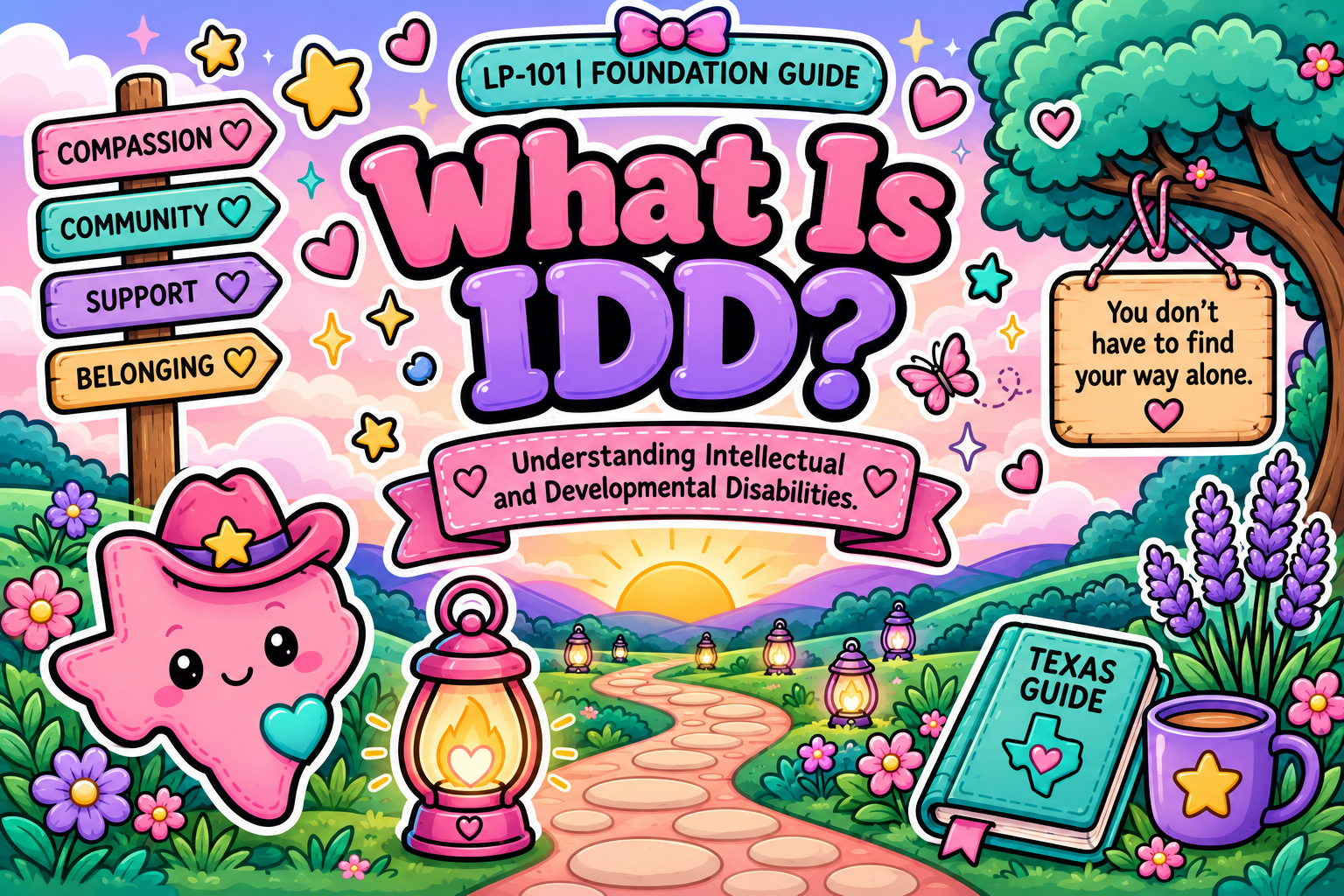
🏮 LP-101
What Is IDD?
A warm, jargon-free introduction to Intellectual and Developmental Disabilities — what it means, who it includes, and why it matters for every family, advocate, and caregiver.
⭐ ✨ 🏮 ✨ ⭐
You’re in the right place. Let’s light the way together.
🌿 ⭐ 🏮 ⭐ 🌿
🧭 Quick Guide Snapshot
Everything you need to know before you begin — at a glance.
📋 About This Guide
👤 WHO IT’S FOR
Self-advocates, families, caregivers, students, and professionals
📍 BEST TIME TO READ
After a diagnosis, learning about disability services, or wanting to understand IDD
🤝 YOU’LL LEARN ABOUT
- What IDD stands for
- Common characteristics
- How IDD affects people differently
- Common misconceptions
- Why person-centered language matters
⚡ Quick Facts
⏱ READING TIME
8–10 min
🟢 DIFFICULTY
Beginner
⭐ BEST PLACE TO BEGIN
Yes — start here ✨
💡 ⭐ 🏮 ⭐ 💡
🔍 Quick Answer
DEFINITION
Intellectual and Developmental Disabilities
IDD is an umbrella term for a group of conditions that affect how a person learns, communicates, or cares for themselves. These conditions typically begin before age 22 and may affect intellectual functioning, adaptive behavior, or both.
• • •
🔵 Autism Spectrum
🟣 Down Syndrome
🟡 Cerebral Palsy
🟢 Fragile X
⭐ Rett Syndrome
💜 ADHD
🏮 A FRIENDLY REMINDER
IDD is not a single condition — it’s a family of many. No two people with IDD are alike, and every person deserves to be understood as an individual.
🌿 ✨ 💡 ✨ 🌿
🌿 ⭐ 🏮 ⭐ 🌿
🏮 Why This Matters
If you’re new to disability services, you’ll hear the term IDD often.
This guide provides the foundation for everything else you’ll learn in the Lantern Path Foundation Series.
❝ Understanding IDD isn’t just for professionals. It’s for anyone who loves, supports, or advocates for someone. ❞
— Lantern Path Foundation Series
📖
You’ll finish with a clear mental model of IDD — one you can actually explain to others.
🌱
No prior knowledge needed. This is your starting point.
💜
Person-centered, warm, and built for real families and caregivers.
✨ 🏮 ⭐ 🏮 ✨
✏️ 🌸 ⭐ 📖 🌿 💜 ✨
💬 Reflection Box
Every person is much more than a diagnosis. These questions are an invitation to see the whole person — not just the label.
🌱 Questions to Explore Together
❤️
STRENGTHS
What strengths do I see in this person?
💬
COMMUNICATION
How does this person communicate best?
🌱
DREAMS
What dreams and goals do they have?
🌟
JOY
What activities bring them joy and energy?
🤝
SUPPORT
What kinds of support help them succeed?
🏡
MEANINGFUL LIFE
What does a meaningful life look like for them?
🌸 ✏️ 📖 ⭐ 🌿 💜 ✨
🧩 Definitions
🧩
Examples of IDD
IDD is a broad category that includes many different conditions. What matters most is understanding the individual — not the label.
🟣 NEURODEVELOPMENTAL
🟢 PHYSICAL & NEUROLOGICAL
🏮
Every diagnosis is different. Two people with the same diagnosis may experience life very differently.
🌈
Every Person Is Different
Two people with the same diagnosis may have completely different strengths, needs, and personalities. A diagnosis is a starting point — not a ceiling.
💪 WHAT EACH PERSON BRINGS
🌱 PEOPLE WITH IDD CAN & DO
💜
Person-centered planning ensures supports are built around who someone actually is — not just their diagnosis.
Every diagnosis is unique. Two people with the same condition may experience life very differently — different strengths, different needs, different dreams. A label is a starting point, never the whole story.
⭐ 🚫 🌟 🚫 ⭐
🚫 Common Misconceptions
Let’s set the record straight.
❌ MYTH
✅ FACT
❌ MYTH
“Everyone with IDD is the same.”
✅ FACT
IDD is a broad spectrum. Every person has unique strengths, needs, and personality — no two people are alike.
❌ MYTH
“People with IDD can’t learn.”
✅ FACT
People with IDD learn throughout their lives. With the right support and environment, growth is always possible.
❌ MYTH
“A diagnosis tells you everything.”
✅ FACT
A diagnosis is a starting point — not a ceiling. It describes some challenges, not a person’s full potential.
❌ MYTH
“Needing support means inability.”
✅ FACT
Support is a tool, not a limitation. Everyone uses support in different ways — it’s a strength, not a weakness.
💜 Every person with IDD is a whole human being — full stop.
⭐ 🚫 💡 🚫 ⭐
🪜 Understanding IDD
Every person with IDD has a unique story. Here’s how support is built around them.
👤
The Individual
Every journey begins here
┊
✨
Unique Strengths
What makes this person who they are — their abilities, interests, and gifts.
🤲
Unique Support Needs
The specific kinds of help that allow them to thrive day to day.
📋
Person-Centered Planning
A collaborative process that puts the individual’s goals at the center.
· · ·
🛠️
Services & Supports
The tools, programs, and professionals that bring the plan to life.
🏡
Meaningful Community Life
Living, working, and connecting in the community — on their own terms.
· · ·
🏮 Lantern Reflection
A diagnosis can help explain how someone experiences the world. It should never limit what we imagine is possible for their future.
🔥 Campfire Moment
A moment to sit with what matters most.
🔥 ✨ 🏮 ✨ 🔥
Sometimes a diagnosis feels like a spotlight — suddenly every conversation seems to circle back to it.
🕯️
But before any diagnosis… Before any evaluation or label or system…
Someone with favorite songs. Favorite snacks. A laugh that fills up a room. 🎵🍪😄
HOLD ONTO THAT.
The diagnosis may become part of the journey — but it is never the whole story. 🏮
🌙 ⭐ 🔥 ⭐ 🌙
🏮 ✨ 🌿 ✨ 🏮
💡 Lantern Tips
Small moves that make a big difference.
🎧
TIP 01
Use person-first language like ‘a person with autism’ — it honors the whole human, not just the diagnosis.
❓
TIP 02
When in doubt, ask — ‘How do you prefer to be referred to?’ goes a long way.
👀
TIP 03
Notice strengths first. Every person with IDD has them — they just may look different than expected.
🌱
TIP 04
Support is not one-size-fits-all. What works for one person may not work for another.
👥
TIP 05
Include people with IDD in conversations about their own lives. Nothing about us, without us.
🏮
TIP 06
You don’t have to know everything — showing up with curiosity and kindness is enough to start.
⭐ 🌿 💡 🌿 ⭐
⭐ 🏮 💡 🏮 ⭐
❓ Frequently Asked Questions
Real questions. Honest answers. No jargon.
🔵 What does IDD stand for?
IDD stands for Intellectual and Developmental Disabilities. It’s an umbrella term for a range of conditions that affect how a person learns, communicates, or cares for themselves — typically beginning before age 22.
💜 Is IDD the same as intellectual disability?
Not quite. Intellectual disability refers specifically to significant limitations in both intellectual functioning and adaptive behavior. Developmental disability is broader — it includes conditions like autism spectrum disorder, cerebral palsy, and epilepsy that may or may not involve intellectual disability.
🌟 Is autism considered an IDD?
Autism Spectrum Disorder is classified as a developmental disability, so yes — it falls under the IDD umbrella. However, not every autistic person has an intellectual disability. IDD is about the range of support needs, not a single fixed condition.
🌸 Can people with IDD live independently?
Many can, and many do — with the right support. Independence looks different for every person. Some live on their own with minimal help; others thrive in supported living settings. The goal is always the most self-determined life possible.
🏮 What is person-centered planning?
Person-centered planning is a process that puts the individual’s own goals, preferences, and voice at the center of every decision about their care and support. Instead of fitting people into existing services, it builds supports around the life they actually want.
✨ How do I use respectful language when talking about IDD?
Start with person-first language: say “a person with an intellectual disability” rather than “an intellectually disabled person.” Some communities also prefer identity-first language (e.g., “autistic person”) — when in doubt, ask. Above all, use language that dignifies and includes.
💡 ✨ 🏮 ✨ 💡
🏮 ✨ 🏮 ✨ 🏮
A Light for the Road Ahead
You didn’t come this far by accident.
🏮
“Every person with IDD deserves to be seen, heard, and supported in living the life they choose.”
— LANTERN PATH FOUNDATION SERIES
· · ·
Learning about IDD is one of the most meaningful things you can do — whether you are a parent sitting in a waiting room, a new case manager on their first day, a student studying human services, or simply someone who wants to understand.
Because behind every acronym, every form, every service plan — there is a person.
“The lantern doesn’t illuminate the whole path at once. It just shows you the next step. That’s enough.”
— LP Foundation Principle
· · ·
You are part of the light now.
🏮 ✨ 🌿 ✨ 🏮
🗺️ Continue Your Journey
Keep exploring. Every guide lights the next step.
🏛️
NEXT UP · LP-102
What Is a LIDDA?
Learn about Local Intellectual and Developmental Disability Authorities — the regional hubs that connect Texans to services.
⬜⬜⬜⬜⬜ Not started
🏥
COMING SOON · LP-103
What Is HHSC?
Discover the Texas Health and Human Services Commission and how it shapes the services and funding available to people with IDD.
⬜⬜⬜⬜⬜ Not started
🧾
COMING SOON · LP-104
Understanding Medicaid Waivers
Unpack what Medicaid waivers are, how they work in Texas, and how families can access waiver-funded services for people with IDD.
⬜⬜⬜⬜⬜ Not started
⭐ 🗺️ 🏮 🗺️ ⭐
📚 ✨ 🏮 ✨ 📚
📚 Helpful Resources
Trusted organizations to guide your next step.
🏛️
STATE AGENCY · TEXAS
Texas HHSC
The state agency overseeing Medicaid, IDD services, and disability programs across Texas.
🗺️
LOCAL SERVICES · TEXAS
Your Local LIDDA
Find the Local IDD Authority in your area — your regional gateway to services and support.
⚖️
LEGAL RIGHTS · TEXAS
Disability Rights Texas
Free legal services protecting the rights of Texans with disabilities. Advocacy when it matters most.
👨👩👧
FAMILY SUPPORT · TEXAS
Texas Parent to Parent
Connecting Texas families of people with disabilities — peer support, resources, and community.
🌱
ADVOCACY · TEXAS
The Arc of Texas
Promoting and protecting the human rights of people with IDD and actively supporting their full inclusion.
🏮
FOUNDATION SERIES · LP
Lantern Path Guides
Continue your learning with the full Lantern Path Foundation Series — one guide at a time.
📚 ✨ 🏮 ✨ 📚
🎉 ⭐ 🏮 ⭐ 🎉
🌟 Key Takeaways
The most important things to carry with you.
🌟
IDD Is an Umbrella
It covers a broad range of conditions — not one single diagnosis.
👤
Every Person Is Unique
No two people with IDD are exactly alike in strengths, needs, or personality.
📋
Person-Centered Planning
Support built around the individual’s own goals leads to better outcomes.
🏡
Inclusion Is Possible
With the right support, people with IDD can live, work, and thrive in the community.
💜
Language Matters
Person-first and identity-first language both honor dignity — when in doubt, ask.
🎉 ✨ 🏮 ✨ 🎉
 Lantern Path